
Where Coralville City Directory Collections Begin
No complete official Coralville-only run was found. The useful shelf is regional: it joins Iowa City and Johnson County volumes, telephone books, newspapers, yearbooks, atlases, and farm directories. A city directory entry should therefore be read in the geographic scope printed on that volume's title page, not assumed to cover every home inside today's Coralville limits.
| Collection | Years | Where Held | Access |
|---|---|---|---|
| Smith's Iowa City and Johnson County directory | 1922 | Internet Archive scan | Open images and OCR |
| Iowa City area directories | 1856, 1857, then varied runs through 1959 | Iowa City Public Library and partner collections | Print, microfilm, or licensed database |
| Iowa City telephone books | About 1900 through 1962, in listed runs | Library of Congress and ICPL | Digital and library research |
| Coralville Courier archive | 1968-1988 | Coralville Public Library | Searchable online archive |
| JCHS atlases and farm directories | Atlases 1870-1978; farm directories 1980s-1990s | Johnson County Historical Society | Appointment research |
| University directories | Student directories 1900-1970 | University of Iowa Archives | Finding aid; some later limits |
Publisher, inclusion, and format vary, and a missing name may reflect a gap or a different geographic label. Confirm an unverified year with the holding library before planning a visit.
Coralville City Directory Help at Local Libraries
The Coralville Public Library genealogy page is the local starting desk. It routes researchers to the Courier, Digital History, FamilySearch, HeritageQuest, HeritageHub obituaries, Iowa newspapers, and in-library Ancestry and Fold3. Access differs by source, so note whether the item is open online, tied to a card, or limited to a library workstation.
The Johnson County Library genealogy desk adds volunteers, books, microfilm, directories, yearbooks, histories, maps, and an obituary card catalog covering 1977 through 2000. Volunteer hours are Monday through Saturday from 9 a.m. to 4 p.m. and Sunday from 2 to 4 p.m. ICPL then supplies regional directories, phonebooks, census schedules, plat indexes, Sanborn maps, yearbooks, and more than 1,000 local-history items.
Coralville Digital History Adds Names to the Shelf
Printed city directories show compact facts, while Coralville Digital History can supply the story around them. Its six collections cover Fourth of July parades, two oral-history groups, Capturing Local History, library photographs, and Images of America: Coralville, Iowa. Search names along with schools, churches, businesses, events, and landmarks, then save the item title, collection, date, and repository identifier.
Oral history is firsthand memory rather than an official index. Use it to generate spellings, nicknames, organizations, and place terms, then test those clues in a dated book, newspaper, deed, or census.
The city history supplies an era guide for those searches. Mill and river terms fit the years after 1843; the Coralville name dates to 1866 and incorporation to 1873. The 1876 schoolhouse and Old Town Hall offer later civic anchors. Reservoir work, I-80 construction, Coral Ridge Mall, and Iowa River Landing identify newer phases that can be tested in photographs, Courier articles, meeting packets, maps, and parcel files. This timeline is not proof about a person, but it helps choose the right vocabulary and repository.
University Directories Bridge Coralville and Iowa City
The University of Iowa's student-produced directories span 1900 through 1970, with the heaviest run from 1900 through 1920. Finding-aid entries include 1904 and 1911-1912 material. These volumes can help when a person moved between campus, Iowa City, and Coralville, but they document an institutional link rather than a complete city population.
The University Archives describes the directory collection. This captured view shows the scope and archival context.
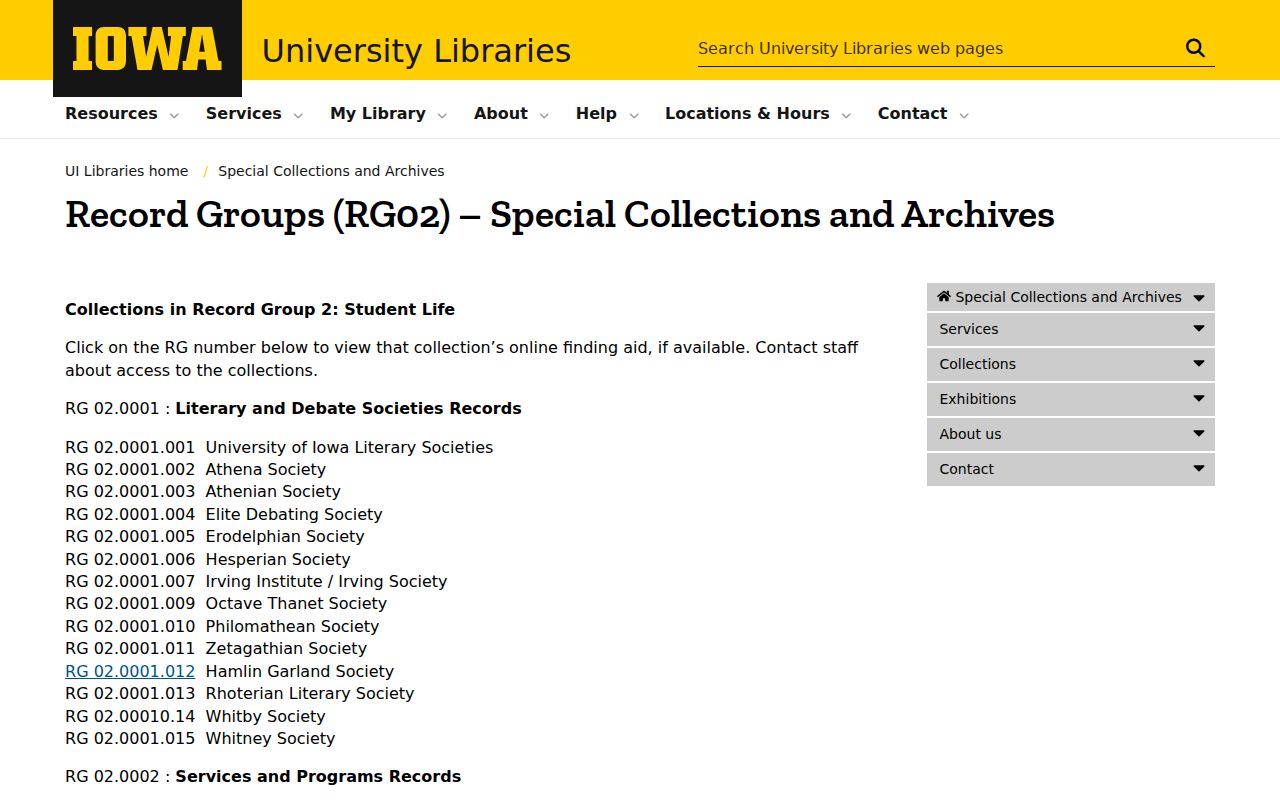
The finding aid is best used to identify a volume and its access conditions before contacting the archive.
How to Read a Coralville City Directory Clue
Smith's 1922 volume offers a real example: the alphabetic line for Comb James M lists “baker” and Martha Washington Doughnut Shop. It establishes a name, occupation, and business connection, but that line alone does not establish a home address. The scan's street and household section is the next place to look, and its “Coralville rd” wording is a reminder to retain the period's own place language.
| Name | Alphabetic name as printed; initials and spelling must be preserved |
|---|---|
| Occupation or business | A role or employer may follow the name |
| Address clue | Check the volume's street or household section rather than infer one |
| Relationship notation | Spouse, widow, or householder marks vary by edition |
| Scan condition | OCR is only a finding aid; verify the page image and abbreviation key |
- Criss-cross directory
- A reverse section arranged by street or address rather than surname.
- Householder index
- A list centered on named heads or household contacts, not necessarily every person at the address.
- Abbreviation key
- The volume's own guide to shortened roles and address terms; read it before expanding any mark.
Internet Archive describes the 1922 item as a 476-page photocopy and notes that pages 459 through 461 are out of order. Always cite the image page, not just an OCR hit.
Coralville City Clerk Records Beyond Printed Directories
For municipal people records, the City Clerk keeps proceedings, cemetery plots, contracts, claims, licenses, permits, elections, and board material. These records can document a dated public role or city action after the printed shelf thins out. They do not form a resident roll, so preserve the role printed in the record.
The City Clerk page identifies the record categories and custodian. The captured page provides a useful visual guide to that modern municipal shelf.
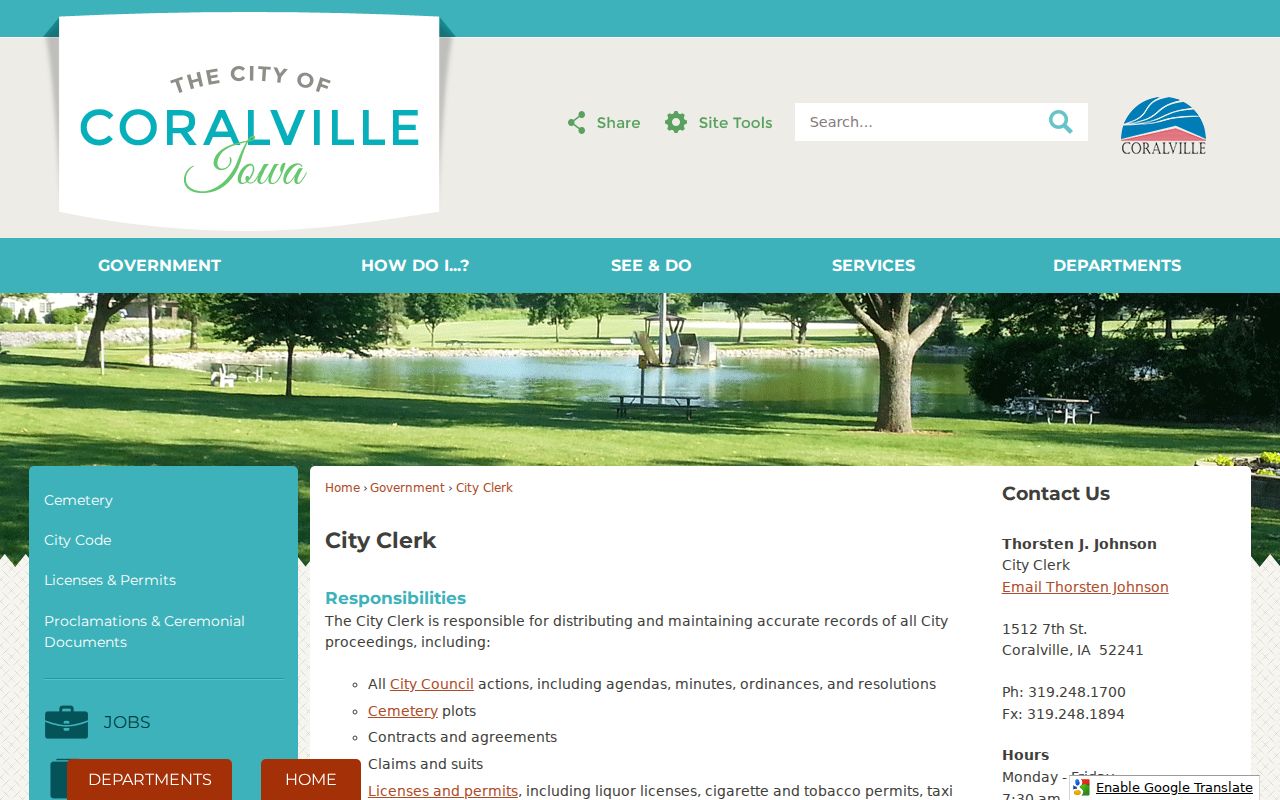
City Hall is at 1512 7th Street, with the clerk at 319-248-1700 and listed weekday hours from 7:30 a.m. to 5 p.m.
Coralville Council Records Form a Dated Civic Directory
The agenda center can trace officials, appointees, speakers, project participants, and formal actions. Its controls include time period, start and end dates, search terms, category, and year browse. Categories include council, work sessions, planning and zoning, adjustment, parks, arts, the Library Board, and the policing advisory board; the archive reaches at least 2011.
Read the packet and minutes before labeling a name. A single appearance may show comment, attendance, an application, or a past appointment, not a continuing role. Save the meeting date, category, document type, and action alongside the name.
Coralville's modern archive continuity also helps bridge the end of printed reference books. Search a surname, street, subdivision, project, or public body within a tight date window. If a result offers an agenda, packet, minutes, media, and download, treat each as a separate source: the agenda states what was scheduled, the minutes summarize what occurred, and a packet may preserve the application or supporting correspondence. Public contact details should stay tied to the dated civic role in which they appear.
When Coralville City Directory Research Reaches a Closed Shelf
A missing online item should lead to its custodian, not to a claim that no record exists. For older permit files, Community Development at 319-248-1720 is the fallback because the public permit portal begins in 2017. Oak Hill Cemetery has no public interment index, so plot ownership and burial questions go to the City Clerk by phone or in person.
Police records have their own route through the non-emergency line at 319-248-1800. The Coralville Police records page explains requests, fees, and confidentiality.
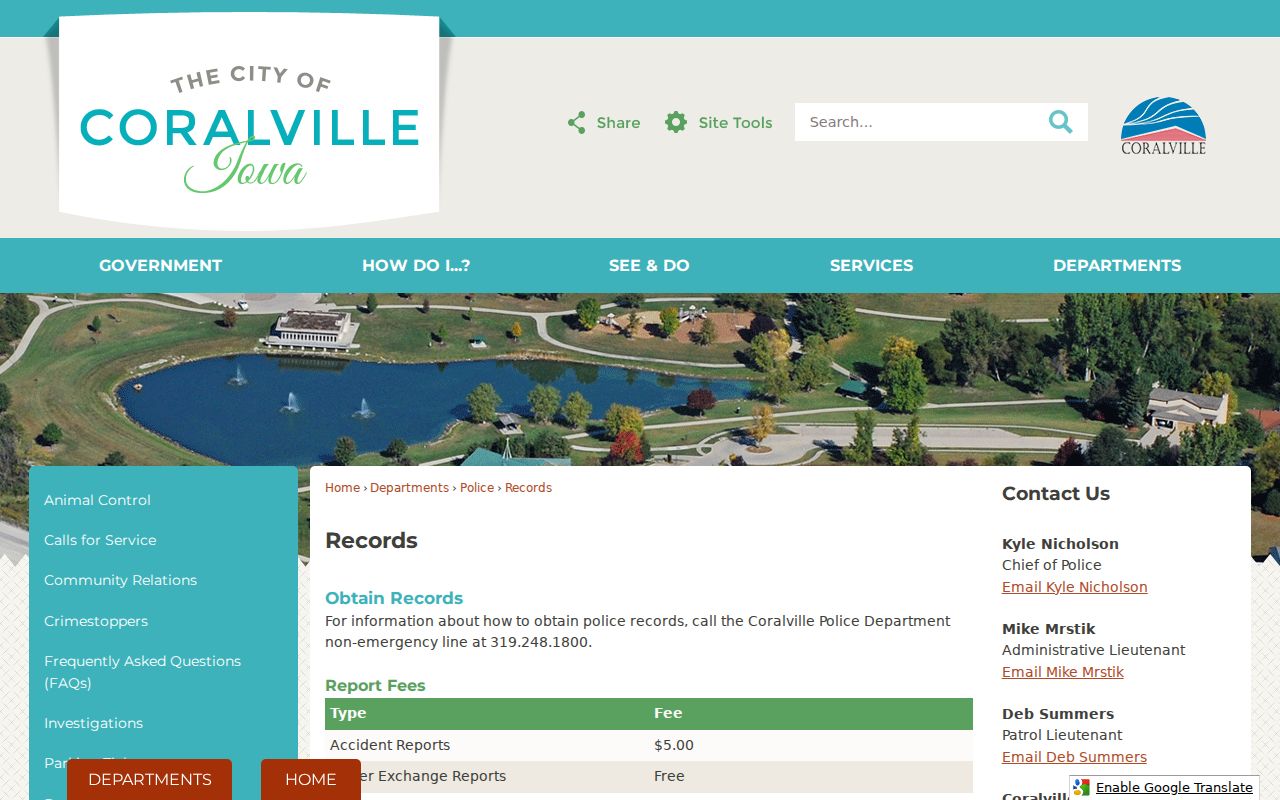
That page lists a $5 accident report, a free driver exchange report, photocopies at $0.25 per page, and other actual production costs. Iowa Code can restrict some records.
For a municipal item outside those routes, make a narrow Iowa Chapter 22 request to the city office that holds it. State the record class, date range, meeting, permit, action, address, or project, and ask about electronic delivery, redactions, retention, and estimated cost. Chapter 22 accepts in-person, written, telephone, and electronic requests, but it does not require an office to build a new resident index. A focused request for an existing file is more useful than a name-only demand across every department.
Trace a Coralville Household Across City Directory Years
A sound family-history trail follows names one edition at a time and leaves room for uncertainty. Coralville's shifting labels make this especially important. Early records may say township, mill, school, road, post office, Iowa City, Coral Mills, or Johnson County rather than use today's city field.
- Find the earliest likely alphabetic entry and save its exact spelling, role, and source page.
- Check the next available edition, recording both appearances and gaps instead of smoothing them over.
- Use the street or reverse section to test an address, then compare a plat or deed when the road wording changed.
- Pair directory years with census schedules, newspaper notices, yearbooks, or a dated photograph.
- Close the later trail with an obituary, cemetery confirmation, probate record, or another independent source.
A disappearance can mean a move, death, omission, unlisted status, coverage change, or a shift in how the area was labeled. It is a question to investigate, not an event by itself. If the search shifts to current official sources, use the Coralville resident lookup workflow and keep historical evidence separate from present records.
Johnson County's preserved series can extend the trail before or between book runs. The State Historical Society inventory includes an 1844 census, assessor books from 1859 through 1912, voter registration from 1897 through 1904, early board minutes, and court, probate, naturalization, deed, mortgage, tax, and vital material. These are series to request or browse, not one combined name portal. Record the office, series title, span, access medium, and original place label for each result.